
To collect data from the North Sea, the Maritime Information Provision Service Point (MIVSP) installs sensors on platforms at offshore wind farms. For this, technical manager Alex Brokx and test manager Theo van der Kooi regularly go out to sea themselves. “Offshore, thorough preparation and collaboration are the key to success.”
“You have theory, you have practice, and then you have reality.” This well-known saying within the MIVSP team at Rijkswaterstaat says a lot about the challenging circumstances the team faces, but also about the different phases in which they carry out their work. Theory refers to the carefully designed plans with which everything begins, including computer models that determine how a wide range of sensors can be mounted on a transformer platform at an offshore wind farm in order to collect as much socially relevant data as possible. Practice takes place at the test location of the Offshore Expertise Centre in Stellendam and at the shipyard where the platforms are constructed. Here, the team implements their ideas and checks whether the sensors function as intended, both individually and in combination. Reality begins when the platforms go offshore. Only at sea does everything truly come together, and it becomes clear whether all the required data actually reaches the shore.
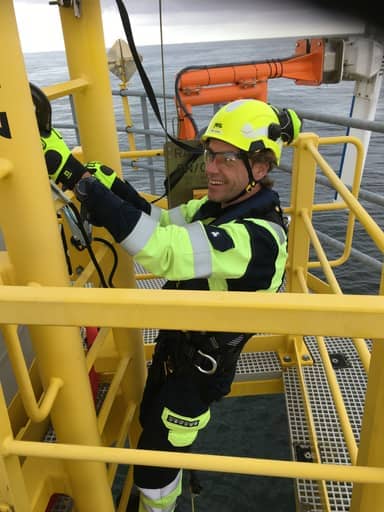
Theo van der Kooi, Rijkswaterstaat
Important: testing in every phase
Test manager Theo van der Kooi illustrates how theory, practice and reality can differ with a concrete example. “Air Traffic Control Netherlands asked us to add a new antenna that can receive messages from aircraft so they can determine their precise location. We had designed the antenna and determined its optimal position on the sensor mast. However, during testing at the shipyard we discovered that the antenna had been mounted on the wrong side of the mast, so we moved it. But when we went offshore, it turned out that the antenna was positioned directly in front of a camera belonging to platform owner TenneT, the national electricity grid operator. We then had to come up with a new solution so that the antenna would function properly while the camera would still have a clear view of the deck.” This example clearly shows why it is so important to test in all three phases: at the test location, at the shipyard and at sea.
Offshore work Is essential
For technical manager of hydro- and meteo sensors Alex Brokx, the work does not stop on land either. “Some sensors can only be installed offshore,” he explains. “For example, some are mounted on the jacket—the steel frame on which the platform rests. That jacket is transported to sea about a year in advance, and during that time other parties still need to carry out various activities on it. That’s why we cannot attach anything to it beforehand. We can also only connect the cables between the jacket and the so-called topside at the very last stage. In any case, all sensors still need to be precisely calibrated on location. For KNMI sensors, for example, it is important that we determine the exact height of the anemometer at sea. That depends on the depth of the location and the height of the platform itself. In reality, this can easily differ by up to 20 centimeters from the predefined value. And in this work, that level of precision really matters.”
Preparation and collaboration are essential
In offshore work, thorough preparation and close collaboration are key to success, says Van der Kooi. “There are multiple parties present at sea. During the first phase, when the platform is being put into operation, there is crew from the accommodation vessel Seafox, which we use as our base. In addition, there are people from TenneT for testing and commissioning—checking whether all installations meet the required standards. There are also people from the shipyard where the platform was built—so far HSM. And finally, there is our offshore team from Rijkswaterstaat—Robert Keupers, Delfine Renson, and ourselves. To make the most efficient use of our time offshore, we need to carefully plan and coordinate all activities. For each sensor, we define in advance what we will do, where we will do it, what safety requirements apply, which people are needed, and what permits and equipment are required. After all, you can’t just go back if you’ve forgotten the right wrench.”
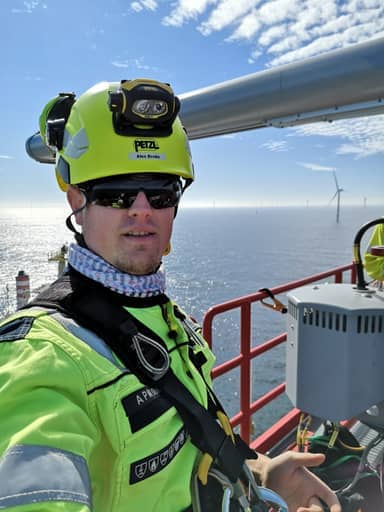
Alex Brokx, Rijkswaterstaat
Always dependent on the weather
Ultimately, however, nothing offshore is fully predictable. At sea, the weather determines whether you can even reach the platform or carry out any work at all. Brokx explains: “Recently, we started the day with a bright, sunny morning. After lunch we were supposed to resume work, but before we had even changed into our gear, we were told over the radio that it was cancelled. The weather had turned—there was a thunderstorm coming in.” In addition, the different parties depend on one another, he emphasizes: “If TenneT is working on high-voltage systems, no one else is allowed to do anything. If you were planning to paint, that’s not happening. That’s why we have a daily coordination meeting with all parties. You also see the same people at every meal. The platform and the accommodation vessel temporarily become your entire living environment, shared with about fifty people. That’s why it helps that we already know each other from the shipyard. We understand each other’s roles and support one another whenever possible.”
Everything takes more time offshore
The duration and frequency of offshore work vary per platform. Van der Kooi explains: “What you can already do at the shipyard makes a big difference. With the first platform—Borssele Alpha—we only received our sensors a few days in advance, so we could only carry out short but intensive testing. With Borssele Beta, we had more time available. These platforms were still built in Schiedam, where we were present at the yard daily. The next two platforms will be built in Dubai, which will be a completely different experience. It’s uncertain how much we’ll be able to test at the yard there. And whatever you cannot complete there will come back to you offshore, often doubled. Everything takes much more time at sea. One reason is that you always have to work in pairs—for safety, but also to be able to consult immediately. You only have access to the situation at that specific moment. Moreover, you sometimes need a great deal of creativity to find new solutions within the constraints you have on site.”
Great to see: data used in practice
Being offshore for extended periods is not always easy for the team. Brokx says: “We wear fluorescent, fire-resistant clothing with heavy boots and helmets. That’s obviously important for safety, but at temperatures of 30 degrees, it’s really hard to endure.” Van der Kooi adds: “The last time we arrived on Friday morning by boat, I received a call before lunch from my daughter telling me she had graduated from secondary school. Of course, you want to celebrate that, but I still had to wait five days before I could go home.”
Despite this, they are more than willing to do it. “It’s fantastic to see that important stakeholders actually use the data from our sensors in practice to carry out their societal responsibilities and enable offshore wind energy. Think of organizations such as the Cadastre, the National Water Measurement Network, the KNMI, the Coast Guard, various universities, and of course Rijkswaterstaat itself, for example in the Offshore Wind Ecological Programme.”